
What Is Car Shampoo Formulation?
Car shampoo formulation is a cleaning liquid made just for washing car paint. It’s not the same as dish soap or laundry detergent, even though a lot of people still grab whatever’s under the kitchen sink to wash their car. That’s actually a bad habit.
Regular dish soap strips wax off your paint. It’s built to cut through grease on plates, and it does the exact same thing to the wax layer protecting your car. Car shampoo is different. It’s made to lift dirt, road grime, bug splatter, and bird droppings without eating away the wax or sealant underneath.
Think of your car’s paint like your skin. You wouldn’t wash your face with the same soap you use to scrub a greasy pan, right? Your face needs something gentler that cleans without drying it out. Car paint needs the same kind of care.
A good car shampoo has a mix of surfactants (that’s the stuff that lifts dirt away), lubricants (so your wash mitt glides instead of dragging grit across the paint), and sometimes a bit of wax or polymer to leave some shine behind. Some are ph neutral car shampoo formulas, which just means they won’t mess with your wax coating or any ceramic shampoo layer you’ve already put on.
You’ll find people searching for car wash shampoo, best car shampoo, and even car shampoo and wax combos because everyone wants that one product that cleans and protects at the same time. And honestly, that demand makes sense. Nobody wants to spend their Sunday morning doing three separate steps when one good bottle can handle it.
If you’ve ever gone to a car wash and detail near me kind of place, you’ve probably noticed they don’t just spray any random soap. Professional detailers know that using the wrong shampoo on a $30,000 car is a fast way to lose a customer, so they invest in proper formulas built for paint safety first and shine second.
Now here’s something a lot of people skip. Car shampoo formulation isn’t only for the exterior. There’s also car interior shampoo and car carpet shampoo, which work totally differently. Interior shampoos deal with fabric, foam, and stains, not paint and clear coat. So when someone types “shampoo car seats” or looks for a car seat shampoo service, they’re talking about a completely different formulation than what you’d use with a snow foam cannon outside.
Understanding this difference matters a lot if you’re formulating your own shampoo. Exterior car wash shampoo needs to be gentle on wax and clear coat. Interior shampoo needs to lift oils from skin contact, food stains, and dust without soaking the foam underneath the fabric, because wet foam takes forever to dry and can start smelling bad.
So when you’re building or buying a car shampoo, the first question isn’t “does it clean well.” It’s “what surface is it actually made for.” That one detail decides everything else in the formula, from the pH level to the foam thickness to how long it needs to sit before you rinse it off.
What Makes a Good Car shampoo formulation?
People judge a shampoo by how much foam it makes. Big mistake. Foam looks satisfying, sure, but foam and cleaning power aren’t the same thing. Some of the best car wash shampoo formulas out there barely foam at all, yet they clean way better than the ones that turn your driveway into a bubble bath. So what actually makes a shampoo good? Let’s go through it one by one.
First, the pH level. A ph neutral car wash product sits right around 7, which is the same range as clean water. This matters because acidic or heavily alkaline soaps can strip wax, dull paint over time, or even damage rubber trim and plastic parts. If you’ve put in the work with a carpro reset or a fresh ceramic coating, using a harsh shampoo undoes all that effort in a couple washes. That’s why ph neutral car shampoo has become such a big deal, especially among people who’ve spent money on paint correction or coatings.
Second, lubricity. This is the slickness factor. When you run a wash mitt over your hood, you want it to glide, not scrape. Dirt particles trapped under a dry-feeling mitt act like sandpaper on your paint. That’s how swirl marks happen. Good shampoo adds a slippery feel so those particles float away instead of grinding into the clear coat.
Third, dirt suspension. This is a fancy way of saying the shampoo needs to grab dirt and hold onto it in the water, not let it resettle back on your paint as you rinse. Cheap shampoos let grime just sort of float around and land right back where it came from.
Fourth, rinsability. A shampoo that’s hard to rinse off leaves a filmy residue. That residue attracts more dust and actually makes your car look dirty faster after the wash. Nobody wants that.
Fifth, scent and feel, which sounds small but actually matters for repeat business if you’re running a car shampoo service or a mobile car wash and detailing setup. Customers remember how clean their car smelled. It’s part of the experience, even if it’s not technically part of the cleaning performance.
Brands like meguiars shampoo, adams car shampoo, autoglym shampoo, and turtle wax shampoo all lean into different strengths. Some focus heavily on gloss and wax bonding, like a car shampoo and wax combo, while others like chemical guys maxi suds ii focus more on thick foam and lubricity for hand washing. Snow foam shampoo products, like turtle wax snow foam, are built for pressure washer use and prioritize cling time on vertical panels so the foam can dwell longer and break down grime before you touch the paint.
If you’re formulating your own, you basically want to balance all five of these things together. Lean too hard into foam and you sacrifice cleaning power. Lean too hard into cleaning power and you might end up stripping wax. It’s a balancing act, and that’s exactly why this next part gets into the actual ingredients that make it all work.
Main Ingredients Used in Car Shampoo formulation
Every car shampoo starts with surfactants. These are the cleaning agents that grab oil and dirt off your paint and pull it into the water. Most formulas use a mix of anionic and non ionic surfactants because anionic ones clean strong but can feel harsh, while non ionic ones are gentler and add a bit of slickness.
Next comes the lubricant, usually something like a polymer or a light glycol. This is what gives you that slippery feel when your wash mitt moves across the hood. Without it, you’re basically dragging grit across your paint.
Then there’s the pH buffer. This keeps the formula sitting close to neutral, which is why so many people search for ph neutral car shampoo and ph neutral car wash options. It protects wax, sealants, and any ceramic shampoo layer already on the car.
Foam boosters are added purely for that thick, satisfying lather people love, especially in snow foam shampoo products made for foam cannons. Fragrance and dye come next, mostly for the experience, not the cleaning.
Finally, some shampoos add a small dose of wax or SiO2 for shine, which is how car shampoo and wax combos work.
How Car Shampoo Formulation Works
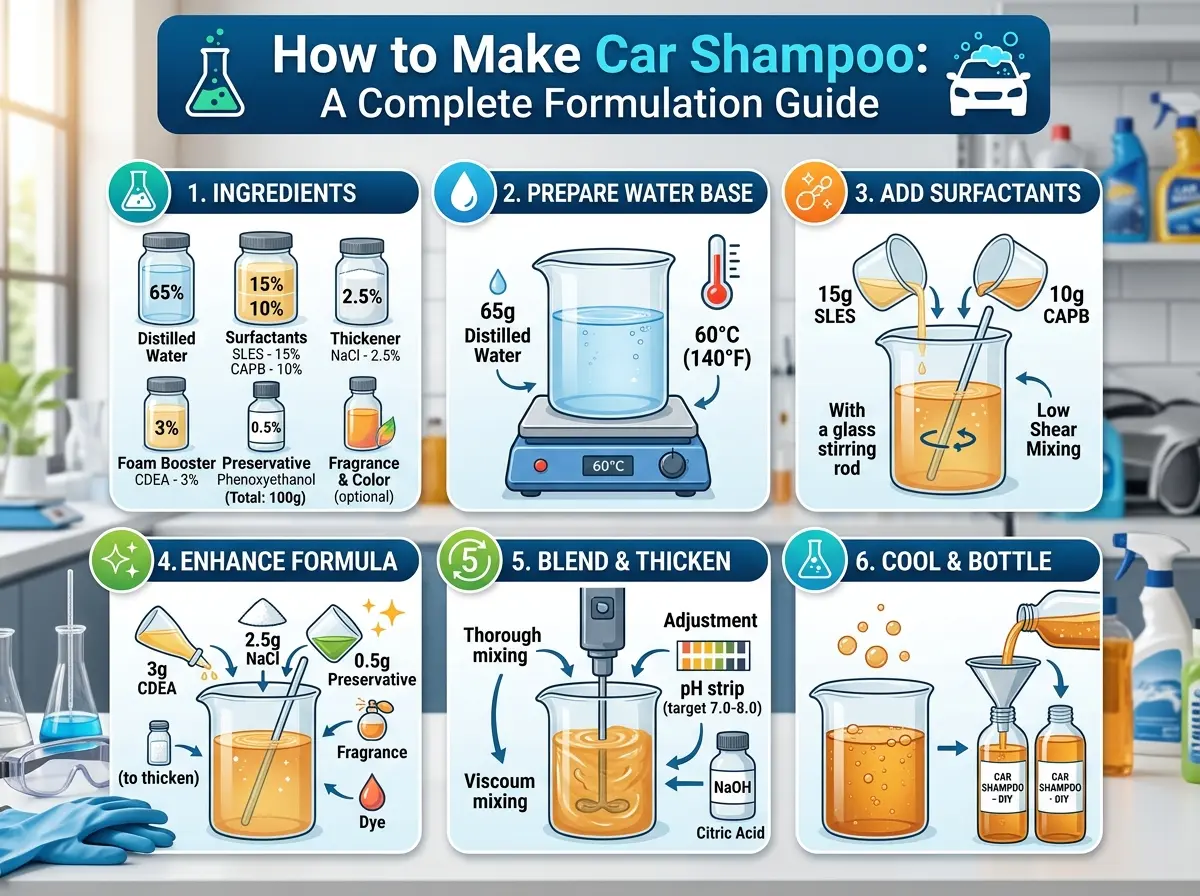
Formulating isn’t just mixing chemicals together and hoping for the best. It starts with picking your surfactant base, since that decides how the shampoo cleans and foams. Then you test pH and adjust with citric acid or a mild base until it sits neutral.
After that, lubricants get blended in slowly, since adding them too fast can mess up the foam structure. Fragrance and dye go in last because heat and mixing speed can break them down early. Every batch gets tested on real paint panels before it’s called finished.
Basic Car Shampoo Manufacturing Process
Making car shampoo on a bigger scale follows a pretty simple order once you know the steps. You start by filling your mixing tank with water, since water makes up most of the formula anyway, usually around 70 to 80 percent.
Next, you add your surfactants slowly while the mixer runs on low speed. Going too fast here causes excess foam in the tank, which makes it hard to add the rest of your ingredients properly.
Once the surfactants are blended in, you check the pH. If it’s too high or too low, you fix it with small amounts of citric acid or sodium hydroxide until it sits close to neutral. This step is where a lot of home formulators mess up, because guessing instead of testing leads to inconsistent batches.
After the pH is right, lubricants and thickeners go in. These need gentle mixing too, since fast blending can break the texture you’re going for. Then comes fragrance and dye, added near the end because heat from mixing can weaken scent over time.
Last step is quality testing. A small sample gets sprayed on a test panel or an old car hood to check foam, rinse time, and how the paint feels after drying. Only after it passes do you move to bottling.
Important Factors When Making Car Shampoo
A few things can make or break your formula, and most of them come down to paying attention to small details instead of rushing.
Water quality matters more than people think. Hard water messes with surfactant performance, so a lot of manufacturers use deionized water instead of regular tap water.
Ratio control is next. Too much surfactant and you get excess foam with weak cleaning power. Too little and your shampoo won’t lift dirt properly, no matter how good it smells.
Storage stability is another big one. A shampoo needs to sit on a shelf for months without separating or losing its scent. This is why preservatives and stabilizers get added even in small batches.A few things can make or break your formula, and most of them come down to paying attention to small details instead of rushing.
Water quality matters more than people think. Hard water messes with surfactant performance, so a lot of manufacturers use deionized water instead of regular tap water.
Ratio control is next. Too much surfactant and you get excess foam with weak cleaning power. Too little and your shampoo won’t lift dirt properly, no matter how good it smells.
Storage stability is another big one. A shampoo needs to sit on a shelf for months without separating or losing its scent. This is why preservatives and stabilizers get added even in small batches.
Common Problems in Car Shampoo Formulation
Even experienced formulators run into trouble sometimes, and most problems come from rushing a step or skipping a test.
The biggest issue is streaking. This usually happens when the surfactant to water ratio is off, or when the shampoo doesn’t rinse clean enough. If you’re getting streaks on a test panel, don’t just add more water and hope. Go back and check your surfactant blend first.
Another common problem is weak foam that disappears in seconds. This happens when foam boosters weren’t measured right, or when they got mixed in too fast and broke down before bottling. Foam issues are usually a mixing speed problem, not an ingredient problem.
Separation is another headache. If your shampoo looks fine one week and then splits into layers a month later, your formula is missing a proper stabilizer, or the ratio between water and oil based ingredients wasn’t balanced.
Some batches also come out too harsh on wax. If customers say their car feels dry after washing, or wax seems to disappear faster than normal, your pH probably isn’t neutral like it should be. This is a common complaint with cheap auto shampoo brands that skip proper pH testing to save money.
Lastly, scent fading fast is usually a sign fragrance got added while the mixture was still too hot.
How to Test Car Shampoo Before Selling
Never sell a shampoo you haven’t tested properly, even if it looks perfect in the bottle. Testing catches problems before your customers do.
Start with a pH test using simple strips or a digital pH meter. You want it sitting close to neutral, especially if you’re marketing it as ph neutral car shampoo.
Next, do a foam test. Shake a small sample in a jar and watch how thick the foam gets and how fast it breaks down. Compare it side by side with a shampoo you already trust.
Then run a real wash test on an actual car panel or an old hood. Check how it feels going on, how it rinses off, and whether it leaves any film once the paint dries.
Finally, let a sample sit for a few weeks in different temperatures to check for separation or fading scent before you commit to a full batch.
Table of Contents
Frequently Asked Questions
Car shampoo price in Pakistan?
Prices swing a lot depending on the brand and size. A basic local car shampoo bottle can start around 400 to 600 rupees, while imported brands like meguiars shampoo or autoglym car shampoo often cost two to three times more because of shipping and import tax.
Best Car Wash Shampoo in Pakistan?
A lot of local detailers lean toward brands they can buy in bulk cheap, but more people are switching to trusted names like turtle wax car shampoo or adams car shampoo as awareness about paint safety grows.