

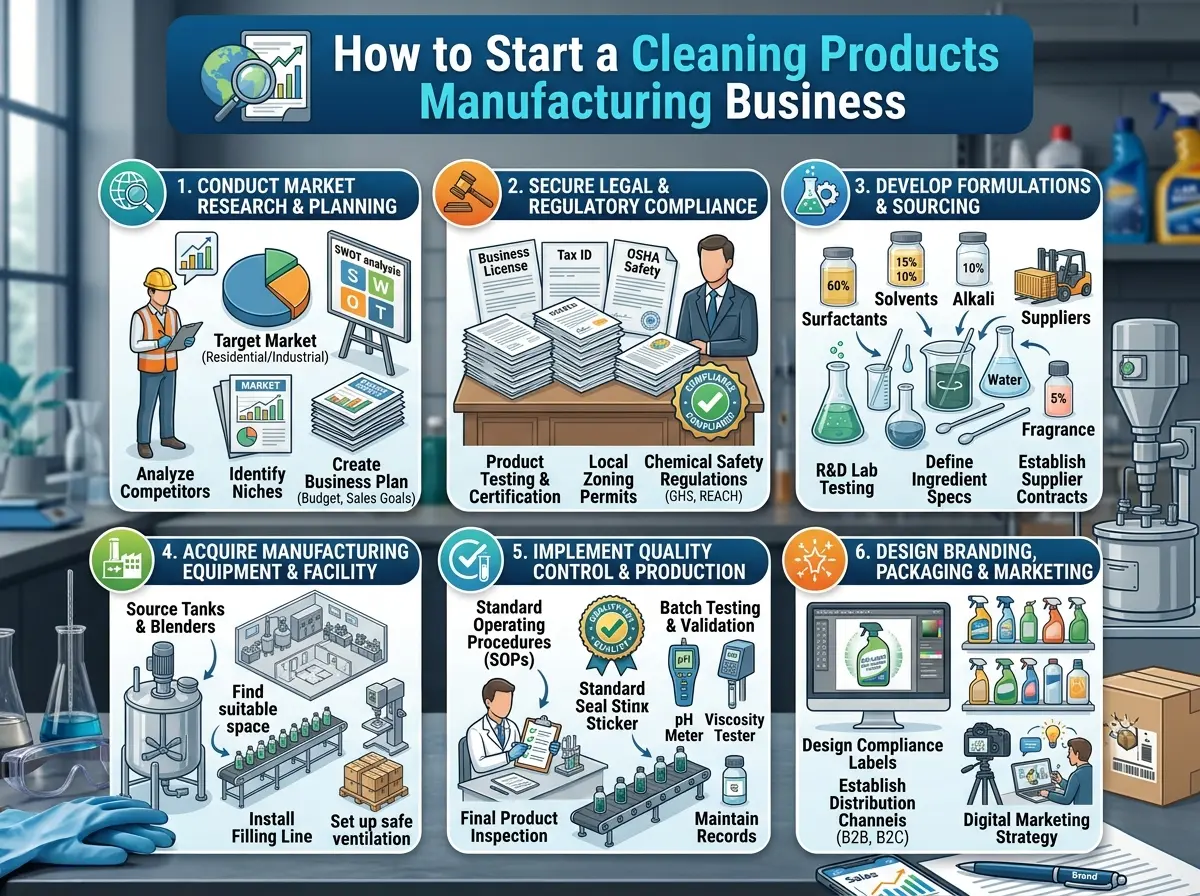
What Is a Commercial Cleaning Formulation Manufacturing Business?
A Commercial Cleaning Formulation Manufacturing business makes soaps, detergents, degreasers, disinfectants, or any liquid and powder product used to clean homes, offices, or factories. You’re not just selling a product. You’re making it from raw chemicals, testing it, packaging it, and getting it into people’s hands.
This is different from being a commercial cleaning supplier who just buys finished products from a factory and resells them to offices and businesses. A supplier stocks shelves. A manufacturer builds the actual formulaion from scratch, controls the ingredients, and takes responsibility for how well the product performs.
There are a few paths people take here. Some start small, mixing dish soap or floor cleaner in their garage and selling to local shops. Others aim bigger, wanting to become one of the cleaning chemicals manufacturing companies that supply hospitals, hotels, or factories in bulk. Both paths are real, and both can be profitable, but they need completely different levels of investment and planning.
A lot of people search cleaning products manufacturing business in Pakistan because the demand keeps growing every year. Homes need floor cleaners and dish soap. Offices need disinfectants and glass cleaners. Factories need heavy duty degreasers and industrial strength cleaners. Every one of these markets needs its own type of manufacturer, and honestly, most areas don’t have enough small manufacturers filling that gap yet.
You don’t need to compete directly with the big household cleaning products companies right away. Companies like that already dominate supermarket shelves with brand recognition most new manufacturers can’t touch in year one. Instead, smart beginners target a specific niche first, like office cleaning products suppliers who need bulk glass cleaner and disinfectant, or local commercial laundry detergent manufacturers style contracts with small hotels and laundromats.
Think about it like this. If you try to be everything to everyone on day one, you’ll run out of money before you find your footing. But if you pick one clear lane, say bathroom disinfectant for local gyms, you can actually build a real reputation and steady orders before expanding into other products.
This business also isn’t just chemistry. You’re dealing with packaging suppliers, raw material sourcing, quality testing, and eventually distribution once orders start coming in. A lot of new manufacturers get so focused on the formula itself that they forget bottles, labels, and boxes take planning too, especially if you’re trying to look professional next to established cleaning detergent manufacturers already sitting in stores.
So before you touch a single chemical, get clear on this. Are you building a small batch operation selling locally, or are you aiming to become a real cleaning products manufacturing company supplying bulk orders down the line? That decision shapes your budget, your equipment, and honestly your entire first year.
Choose the Right Cleaning Product to Manufacture
This step trips up more beginners than anything else. Everyone wants to make everything at once, dish soap, floor cleaner, glass cleaner, degreaser, all in month one. That’s usually a mistake.
Start by looking at what’s actually in demand around you. Walk into five local shops and ask what cleaning products move fastest. Talk to a few office cleaning products suppliers if you can, since they’ll tell you straight up what their clients keep reordering.
Dish soap and floor cleaner are usually the easiest entry points since the formulas are simpler and demand is constant. Every household needs them, every month, without fail. Disinfectant sprays have grown a lot too, especially after people got more serious about hygiene in offices and clinics.
If you’re aiming for bulk contracts eventually, degreasers and industrial cleaners open doors with factories and workshops, though these formulas need more testing since they’re handling tougher grime and stricter safety expectations.
Laundry detergent is another solid option, especially if you’re eyeing contracts similar to commercial laundry detergent manufacturers who supply hotels and laundromats in bulk. It’s a repeat purchase product, meaning once a client likes your formula, they keep ordering month after month without much convincing.
Pick one or two products max for your first six months. Master those, get consistent feedback, then expand once you’ve got a steady base of buyers who trust what you’re selling.
Learn the Basics of Cleaning Product Formulation
Before you mix a single batch, you need to understand a few basic ideas that every cleaning product relies on. This isn’t about becoming a chemist overnight. It’s about knowing enough to avoid wasting money on failed batches.
Every cleaning product built around water needs three core parts. First is the active cleaning agent, usually a surfactant, which is what actually lifts dirt and grease away from a surface. Second is water, which makes up the biggest chunk of most formulation, often 70 to 90 percent depending on the product. Third is your supporting ingredients, things like fragrance, dye, thickeners, and preservatives that round out the final product.
pH is something you’ll hear about constantly once you start formulating. It’s basically a scale that tells you how acidic or alkaline your product is. Dish soap and shampoo type products usually sit close to neutral, around 6 to 8, so they’re gentle on skin and surfaces. Degreasers and heavy duty cleaners sit much higher, often 10 to 13, since that higher alkalinity helps break down grease and grime faster.
Surfactants come in different types too. Anionic surfactants clean strong and foam well, which is why they show up in dish soap and laundry detergent. Non ionic surfactants are gentler and work well for degreasing without excess foam, which matters more in industrial settings where foam actually causes problems with machinery.
Viscosity matters more than beginners expect. This is just a fancy word for thickness. Customers associate thicker dish soap with stronger cleaning power, even when that’s not always true chemically. That’s why a lot of manufacturers add thickening agents like salt or xanthan gum, purely to hit that expectation.
Stability is the last piece. A good formula needs to sit on a shelf for months without separating, changing color, or losing its scent. This is where a lot of home formulators get caught off guard, since a formula that looks perfect fresh out of the mixer can fall apart within weeks without a proper preservative or stabilizer.
Develop or Select a Cleaning Product Formula
Once you understand the basics, you’ve got two real options here. Build your own formula from scratch, or license and adjust an existing formula from a supplier or consultant who already knows what works.
Building from scratch gives you full control and lower long term costs, but it takes real trial and error. You’ll mix small test batches, adjust ratios, test on real surfaces, and repeat this process multiple times before landing on something consistent. This route works best if you’ve got patience and access to basic raw materials locally.
Buying or licensing a formula skips a lot of that trial and error. Plenty of chemical suppliers and consultants sell tested formulas for dish soap, floor cleaner, or degreaser for a reasonable fee. This route gets you to market faster, though you’ll want to tweak the formula slightly to match your local water quality and available raw materials, since a formula built for one region doesn’t always perform the same somewhere else.
Whichever route you pick, always test your formula on the actual surface it’s meant for before committing to a full production run. A degreaser formula that works great on paper can still flop on real engine grime or factory floor grease if you skip this step.
Common Ingredients Used in Cleaning Products
Most cleaning products, no matter what they’re made for, pull from the same basic list of ingredients. Once you understand these, reading any formula becomes a lot easier.
Surfactants sit at the top of that list. These are the ingredients that actually lift dirt, oil, and grease away from surfaces. Sodium lauryl sulfate and sodium laureth sulfate show up constantly in dish soap and shampoo because they clean well and foam thick, which customers associate with strength. For gentler formulas, cocamidopropyl betaine gets blended in to soften the harshness of stronger surfactants.
Water makes up the bulk of almost every formula, often 70 to 90 percent. Deionized water is preferred over regular tap water since minerals in hard water can mess with how surfactants perform and even cause cloudiness in the final product.
Builders and alkaline agents come next, things like sodium carbonate or sodium metasilicate. These raise pH and boost cleaning strength, especially in degreasers and heavy duty cleaners where grease needs a stronger push to break down.
Thickeners like salt or xanthan gum control the texture of your product. A lot of household cleaning products companies use salt specifically because it’s cheap and easy to control, just by adding it slowly while watching viscosity change in real time.
Preservatives keep your product safe from bacteria and mold growth over time, since water based products without any preservative can spoil within weeks. Common ones include sodium benzoate or a blend called Kathon.
Fragrance and dye round things out purely for customer experience. They don’t affect cleaning power at all, but they matter a lot for repeat purchases since people associate certain scents with cleanliness, whether that’s true chemically or not.
Equipment Needed for Cleaning Product Manufacturing
You don’t need a massive factory to start. Plenty of small manufacturers begin with basic equipment and scale up once orders start rolling in steadily.
A mixing tank is your first real investment. For small batches, a simple stainless steel tank with a manual or low speed electric mixer works fine. Stainless steel matters here since some plastics react with stronger chemicals over time, especially in alkaline degreaser formulas.
A pH meter is non negotiable. Guessing pH with your eyes or by feel leads to inconsistent batches, and inconsistent batches lose customer trust fast. A basic digital pH meter costs relatively little and pays for itself within the first few batches by catching mistakes early.
A viscometer helps measure thickness consistently, though in the early days, plenty of small manufacturers just compare new batches against a trusted sample by eye and feel until they can afford proper testing equipment.
Weighing scales, ideally accurate to at least one gram, matter more than people expect. Small ingredient differences, especially with preservatives and fragrance, throw off an entire batch if measured carelessly.
Filling equipment comes next, ranging from manual hand pumps for very small operations to semi automatic filling machines once order volume grows. Bottles, caps, and labels round out your basic setup, and a scrubber roll price is worth checking early too if you’re planning to bundle cleaning tools alongside your liquid products for retail customers.
Set Up a Small-Scale Production Area
You don’t need a commercial warehouse to get started. A clean, dry room with good ventilation is enough for most beginners, whether that’s a spare room, garage, or a small rented space.
Ventilation matters more than people think, especially if you’re working with degreasers or anything alkaline. Fumes from concentrated chemicals build up fast in a closed room, so even a basic exhaust fan or open window setup makes a real difference for your health during long mixing sessions.
Flooring should be easy to clean and resistant to chemical spills. Tiled or sealed concrete floors work best since carpet or wood soaks up spills and gets damaged fast. A drain nearby helps too, since rinsing equipment after every batch becomes part of your daily routine.
Storage space needs its own section, separate from where you mix. Raw chemicals should sit away from finished products, and acidic ingredients should never sit right next to alkaline ones on the same shelf, since a leak or spill mixing the two can cause a dangerous reaction.
Keep a dedicated area just for labeling and packaging too. Mixing chemical work and packaging work in the same tight space gets messy fast, especially once you’re running multiple batches back to back.
Basic safety gear matters here as well. Gloves, goggles, and a first aid kit should always be within reach, even for small home operations. A lot of new manufacturers skip this early on and regret it the first time they get a chemical splash on their skin or in their eyes.
Lighting is another small detail people overlook. Good lighting helps you catch color changes, cloudiness, or separation issues in your batches immediately, instead of noticing a problem days later once it’s already bottled and sitting on a shelf.
How to Manufacture Cleaning Products
Once your space and equipment are ready, the actual manufacturing process follows a pattern that stays fairly similar across most cleaning products, whether you’re making dish soap, floor cleaner, or degreaser.
Start by measuring your water first, since it usually makes up the largest percentage of your formula. Pour this into your mixing tank before adding anything else.
Next, add your surfactants slowly while your mixer runs on low speed. Adding surfactants too fast creates thick foam early, which makes it hard to judge how your batch is actually progressing and can even cause overflow in smaller tanks.
If your formula needs an alkaline builder, like in a degreaser, this goes in next, also slowly, since a fast reaction can heat up your tank more than expected. Check your pH at this stage using your meter, adjusting with small amounts of acid or base until you’re sitting in the right range for your specific product.
Thickeners come after your pH is confirmed correct. Add these gradually too, checking viscosity as you go rather than dumping everything in at once and hoping it thickens properly.
Fragrance, dye, and preservatives go in last. These are sensitive to heat and fast mixing, so save them for when your batch has settled and cooled slightly from the earlier mixing stages.
Once everything’s blended, run a small test, checking foam, color, smell, and how the product performs on the actual surface it’s meant for. Only after it passes your own checks should you move toward bottling and labeling for sale.
Testing and Quality Control
Skipping quality control is the fastest way to lose customers you worked hard to get. Every batch needs a check before it leaves your production space, no exceptions, even if you’re only making twenty bottles a week.
Start with a pH check on every single batch, not just your first test batch. Ingredients can vary slightly between suppliers, and even small shifts in raw material quality can push your pH outside the safe range without you noticing unless you actually measure it.
Next, check consistency and color against your original approved sample. Keep a small labeled bottle from your very first successful batch as your reference standard. Compare every new batch against it side by side, since color or thickness drifting slowly over months is easy to miss if you’re only comparing each batch to the one right before it.
Foam testing matters for dish soap, shampoo, and laundry detergent especially. Shake a small sample in a jar and watch how thick the foam builds and how fast it breaks down. If it’s noticeably different from your standard, something shifted in your surfactant ratio.
Real world testing is something a lot of small manufacturers skip, and it’s a mistake. Test your degreaser on actual greasy engine parts, not just a beaker. Test your floor cleaner on actual tile, not just paper towels. Lab results and real world performance don’t always match up perfectly.
Shelf stability testing takes patience but saves you from disasters later. Leave a sample bottle in a hot spot, like near a window, and another in a cooler spot for a few weeks. Check both for separation, color change, or fading scent before you commit to a large batch of the same formula.
Keep records of every batch, including date, ingredients used, and test results. This sounds tedious early on, but it becomes priceless once you’re troubleshooting a bad batch or scaling up production later and need to know exactly what worked before.
How to Calculate Cleaning Product Manufacturing Costs
A lot of new manufacturers price their products based on guesswork, then wonder why they’re barely breaking even after a few months. Real cost calculation isn’t complicated, but it does need every expense accounted for.
Start with raw material cost per batch. Add up the exact cost of every ingredient used, down to the fragrance and preservative, not just the main surfactant or solvent. Small ingredients add up faster than people expect, especially preservatives and dye which seem cheap per gram but get used across every single batch.
Next, factor in packaging costs. Bottles, caps, labels, and boxes all cost money, and cheap packaging that leaks or looks unprofessional can hurt your brand more than it saves you in pennies per unit.
Labor cost matters too, even if it’s just your own time in the early days. Assign yourself a fair hourly rate and multiply it by how long a batch actually takes from mixing to bottling. A lot of home manufacturers skip this step and end up working for less than minimum wage without realizing it.
Utilities and overhead come next, things like electricity for mixing equipment, water usage, and rent if you’re using a dedicated space outside your home.
Add all of this together, divide by the number of units your batch produces, and that’s your true cost per unit. From there, a reasonable markup for cleaning products usually sits between 40 and 60 percent above cost, though this shifts depending on whether you’re selling retail direct to customers or wholesale to shops and offices in bulk.
How to Scale a Cleaning Product Formula
Scaling up sounds simple on paper. Just multiply your ingredients by ten, right? Not quite. A formula that works perfectly in a five liter test batch can behave completely differently once you’re mixing two hundred liters at once.
The biggest issue people run into is mixing time and speed. Small batches mix evenly within minutes using a hand mixer or small motor. Larger tanks need proper industrial mixers, and even then, ingredients near the mixing blade blend faster than ingredients sitting near the edges of a big tank. This means your mixing time needs to stretch longer as your batch size grows, not just your ingredient amounts.
Temperature control becomes a real factor at scale too. A small batch cools down fast after mixing, but a large tank holds heat much longer. If you’re adding fragrance or preservatives that break down under heat, you’ll need to wait longer for a big batch to cool before adding those sensitive ingredients, otherwise you’ll lose potency across the entire batch instead of just a small test sample.
Raw material sourcing shifts at scale as well. Buying surfactant by the liter from a local supplier works fine for small batches, but once you’re scaling toward bulk orders similar to what commercial laundry detergent manufacturers deal with, you’ll need drum quantities and probably a direct relationship with a cleaning chemicals manufacturing companies supplier instead of buying retail sized containers.
Quality control needs to scale too, not just production. Testing one sample from a two hundred liter batch isn’t enough. Pull samples from the top, middle, and bottom of your tank, since separation or uneven mixing can mean different parts of the same batch perform differently once bottled.
Lastly, watch your water source closely as you scale. A well or municipal supply that worked fine for small test batches might introduce more mineral variation than expected once you’re using hundreds of liters weekly, which can quietly shift your product’s consistency without an obvious cause.
Table of Contents
Frequently Asked Questions
Demand Cleaning products manufacturing business in Pakistan?
Demand keeps growing steadily across Pakistan, especially for dish soap, floor cleaner, and disinfectant, since local households and small businesses need these products constantly. Many small manufacturers start in cities like Lahore, Karachi, and Faisalabad, buying raw materials in bulk from local chemical markets before expanding into wider distribution.
Cleaning products manufacturing business profit?
Profit margins vary a lot depending on scale and product type, but small manufacturers often see anywhere from 40 to 70 percent markup once raw material and packaging costs are covered, especially when selling direct to local shops instead of through multiple distributors.
Cleaning products manufacturing business plan?
A solid plan covers your product choice, target customer, initial equipment cost, monthly raw material budget, and a realistic timeline for reaching your first fifty regular customers before expanding your product line further.