
Someone sat down and figured out exactly how much medicine to put in it, what to mix it with, and how to shape it so your body actually absorbs it right. That whole process is called Pharmaceutical formulation.
I got interested in this topic after a friend of mine, who works in a small pharma company in Karachi, started telling me about his daily work. He’d come home and talk about tablets breaking too fast or dissolving too slow, and I had no clue what he meant. So I started reading and asking questions, and honestly, it opened up a whole world I never knew existed.
Most people think medicine is just “the drug.” You take a paracetamol tablet and think that’s just paracetamol pressed into a shape. But that’s not even close to true. A tablet has the actual drug plus a bunch of other stuff that helps it work properly, stay stable on the shelf, and taste okay (or at least not terrible).
This is where pharmaceutical formulation comes in. It’s the science and honestly a bit of an art too, of turning a raw drug into something you can actually take safely. Without it, medicines wouldn’t survive shipping, wouldn’t dissolve in your stomach right, and some would even fall apart in the bottle before you got the chance to use them.
I want to write this guide the way I wish someone had explained it to me. No heavy jargon, no textbook language. Just plain talk about what pharmaceutical formulation actually means, why it matters, and how a plain tablet gets made from scratch.
If you’re a pharmacy student, someone curious about how drugs are made, or just someone who typed “what is pharmaceutical formulation” into Google at 2 in the morning, you’re in the right spot. I’ll walk you through everything step by step, starting with the basics and moving up to real manufacturing stuff.
By the end of this, you won’t just know the definition. You’ll actually understand why a tablet is round, why some pills are coated, why liquid medicines separate if left alone, and why your doctor sometimes says “take this on an empty stomach.” All of that ties back to formulation.
What Is Pharmaceutical Formulation?
Pharmaceutical formulation is the process of combining a drug (the active ingredient that actually treats your illness) with other materials to create a final medicine you can use. Think tablets, capsules, syrups, injections, creams, all of it.
Here’s an easy way to picture it. Imagine you’re baking a cake. Flour alone isn’t a cake. You need sugar, eggs, butter, and heat to turn that flour into something edible and enjoyable. Pharmaceutical formulation works the same way. The drug is your flour, and everything else added to it (binders, fillers, coatings) turns it into a tablet or syrup that your body can actually use.
Without formulation, drugs would just be raw powders or chemicals sitting in a jar. You couldn’t measure an exact dose from that, you couldn’t swallow it safely, and it definitely wouldn’t stay stable for two years on a pharmacy shelf.
So when people search “pharmaceutical formulation definition,” this is basically it. It’s the science of designing a dosage form (tablet, capsule, syrup, injection) that:
Delivers the right amount of drug to your body
Keeps the drug stable until you use it
Makes it safe and comfortable to take
Helps your body absorb it properly
A formulation scientist (also called a formulator) is the person behind this. Their job is to figure out how much drug goes in, what other ingredients help it work best, and how it should be shaped or packaged. It’s actually one of the most detail heavy jobs in the whole pharma industry, because even small mistakes can change how well a drug works.
Now here’s something people often miss. Two tablets can have the exact same drug in the exact same amount, but if they’re formulated differently, one might work great and the other might barely work at all. That’s because the drug itself is only part of the story. How it’s formulated decides how well it actually performs once it’s inside you.
This is why formulation isn’t just mixing ingredients randomly. It’s tested again and again in labs before it ever reaches a pharmacy. Scientists check how fast a tablet dissolves, how long it stays stable, whether it releases the drug too fast or too slow, and whether your stomach can handle it without irritation.
In short, pharmaceutical formulation is the bridge between a raw chemical and a real medicine you trust enough to swallow. And in the next part, we’re going deeper into what an API actually is, since you can’t understand formulation without understanding that piece first.
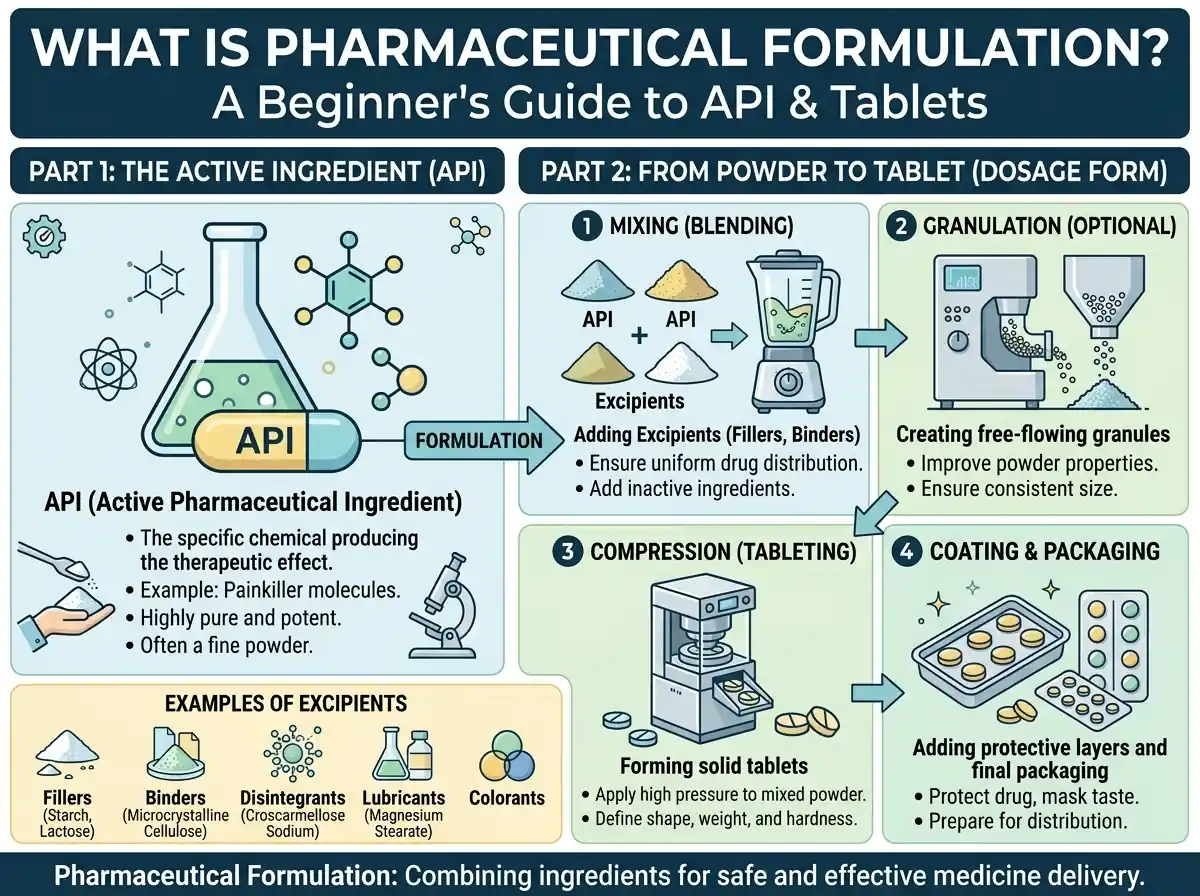
What Is an API? API = Active Pharmaceutical Ingredient
This is the actual drug. The part that treats your illness. If you take a paracetamol tablet, paracetamol itself is the API. Everything else in that tablet is just there to support it.
Think of API as the star player on a football team. It’s the one doing the real work. But a star player still needs a team around him to actually win the match. That’s exactly what excipients do for the API.
APIs come in powder form most of the time. On their own, they can’t be swallowed safely or measured out easily. Some APIs are also unstable, meaning they break down if exposed to air, light, or moisture. So formulators have to protect and support the API properly before it becomes a usable tablet or capsule.
This is also why API in pharmaceuticals is such a huge part of drug manufacturing. Companies spend years perfecting how pure and stable an API is before it even reaches the formulation stage.
What Are Pharmaceutical Excipients?
Excipients are all the extra ingredients added to a drug that aren’t meant to treat anything on their own.
They help bind the tablet together, help it dissolve properly, improve taste, add color, or even help it slide through manufacturing machines smoothly.
Common examples include starch, lactose, cellulose, and magnesium stearate. Each one has its own job. Some hold the tablet together, some help it break apart in your stomach, and some just make swallowing easier.
Pharmaceutical excipients and their functions actually decide a lot about how a tablet behaves. A wrong excipient choice can make a tablet crumble too fast or refuse to dissolve at all.
So basically, API and excipients work as a team. The API cures you. The excipients make sure that cure actually reaches your body the right way.
Main Components of a Pharmaceutical Formulation
Every pharmaceutical formulation is built from a handful of key pieces, and once you know them, the whole puzzle makes sense.
First you’ve got the API, the actual drug doing the healing work we already talked about. Then come the excipients, which handle everything else needed to make that drug usable.
Inside excipients, you’ll find binders, which hold the tablet together so it doesn’t crumble in your hand. You’ve got fillers or diluents, added when the actual drug amount is too small to form a proper tablet size. Disintegrants are there to help the tablet break apart once it hits your stomach, so the drug can release and get absorbed.
Then there’s lubricants, which help the powder mixture flow smoothly through the tablet press machines without sticking. Some formulations also include coatings, which protect the tablet, mask a bad taste, or control how fast the drug releases inside your body.
Every single one of these pharmaceutical formulation ingredients plays a specific role. Miss one, or use the wrong amount, and the tablet might not perform the way it’s supposed to.
Types of Pharmaceutical Formulations
Medicines don’t all look the same because our bodies need them delivered in different ways depending on the situation.
Solid dosage forms include tablets and capsules. These are the most common because they’re easy to store, transport, and dose accurately.
Liquid dosage forms include syrups, suspensions, and solutions. These are often used for kids or people who have trouble swallowing pills.
Then you’ve got semi solid forms like creams, gels, and ointments, mostly used on the skin. And injectable formulations, which go straight into the bloodstream or muscle for fast action.
Each type of pharmaceutical dosage form is chosen based on how fast the drug needs to work, who’s taking it, and how stable the API is in that form.
What Is Tablet Formulation?
Tablet formulation is basically the process of turning a drug and its excipients into that solid, round (or oval) shape you swallow every day.
It’s not as simple as just squeezing powder into a shape. The formulator has to decide how much API goes in, which binders will hold it together, how fast it should dissolve, and whether it needs a coating.
Some tablets are made to dissolve fast, like the ones you place under your tongue. Others are made to release the drug slowly over hours, which is common in extended release pain medicines. That difference all comes down to tablet formulation choices made way before the tablet ever gets pressed.
Getting this right takes testing. A lot of it. Scientists check the hardness of the tablet, how long it takes to break apart, and whether the drug releases at the correct speed once it’s inside you. Get any of that wrong, and the medicine either won’t work well or could even harm you.
Basic Tablet Manufacturing Process
Once the formulation is set, the actual tablet manufacturing process begins, and it usually follows a few clear steps.
First is mixing, where the API and excipients get blended together evenly. This step matters a lot because if the mixing isn’t uniform, some tablets might have too much drug and others too little.
Next comes granulation. This turns the powder mix into small granules, which flow better and press into tablets more evenly. There are two common methods here, wet granulation and dry granulation, and the choice depends on how the API reacts to moisture.
After that is compression, where the granules get pressed into tablets using a tablet press machine. This is where the actual shape, size, and weight of your tablet gets locked in.
Finally, some tablets go through coating, which protects them, hides bad taste, or controls how the drug releases once swallowed.
Pharmaceutical Formulation Development Process
It starts with pre-formulation studies. Scientists study the raw drug itself here. They check things like how it dissolves in water, how it reacts to heat, and how stable it stays over time. This step decides what kind of excipients will even work with that particular drug.
Then comes lab scale formulation. Small test batches get made and tweaked again and again. Maybe the first batch dissolves too slow. Maybe the second one crumbles. Formulators keep adjusting the recipe until it hits the mark.
Once a formula looks promising, it moves to pilot scale batches. These are bigger than lab trials but smaller than full factory production. This step checks whether the formula still behaves the same way when made in larger quantities.
After that, stability testing kicks in. Tablets get stored under different temperatures and humidity levels for months, sometimes years, just to see if they hold up. Nobody wants a medicine that stops working after sitting in a hot warehouse for six months.
Only after all that does a formula move toward full scale manufacturing and regulatory approval.
Factors That Affect Pharmaceutical Formulation
A lot of things can throw off a formulation, and formulators have to think about all of them.
The physical and chemical properties of the API matter a ton. Some drugs hate moisture. Some break down in sunlight. Some just don’t dissolve well no matter what you mix them with.
The route of administration changes things too. A drug meant to be swallowed needs a totally different approach than one meant for injection or for applying on skin.
Patient factors count as well. Kids, elderly folks, and people with swallowing issues often need liquid or chewable forms instead of hard tablets.
Even storage conditions and shelf life targets shape formulation decisions, since a medicine sold in a hot climate needs extra protection compared to one stored somewhere cool and dry.
Quality Control in Pharmaceutical Formulation
Quality control checks every single batch of tablets before they ever leave the factory. Workers test the weight of each tablet to make sure the drug amount stays consistent from one pill to the next. Too much variation and some patients might get too little medicine while others get too much.
Hardness testing checks whether tablets can survive shipping and handling without crumbling into powder. Dissolution testing checks how fast the tablet breaks down in liquid, which tells scientists whether the drug will actually release properly inside your stomach.
There’s also testing for uniformity, moisture content, and purity, making sure nothing harmful snuck into the batch during manufacturing. Every result gets documented and compared against strict limits before that batch gets approved for sale.
This whole system exists because a small mistake in a pharma factory doesn’t just mean a bad product. It means someone’s health could actually be at risk.
Why Pharmaceutical Formulation Is Important?
At the end of the day, pharmaceutical formulation is the reason medicine actually works the way it’s supposed to.
Without proper formulation, even the best drug in the world would be useless. It might not dissolve right, might taste unbearable, might break down before you even get to take it, or might release too fast and cause side effects instead of relief.
Good formulation makes medicine safe, consistent, and easy to use for everyday people, not just scientists in a lab. It’s the reason a diabetic patient can take one tablet a day instead of ten injections. It’s the reason kids can take sweet flavored syrup instead of fighting to swallow a bitter pill.
This whole field works quietly in the background, but honestly, it touches almost every part of your daily life whenever you reach for medicine.
Table of Contents
FAQs
What is pharmaceutical formulation in simple words?
It’s the process of turning a raw drug into a usable medicine like a tablet, syrup, or injection, by mixing it with other ingredients that help it work safely.
What is the difference between API and excipients?
API is the actual drug that treats the illness. Excipients are the supporting ingredients that help shape, stabilize, and deliver that drug properly.
What are the main types of pharmaceutical dosage forms?
Solid forms like tablets and capsules, liquid forms like syrups, semi solid forms like creams, and injectable forms.
Why do tablets need coating?
Coating protects the tablet, hides bad taste, and sometimes controls how fast the drug releases in your body.
How long does formulation development usually take?
It can take several years, since it involves lab testing, pilot batches, and long term stability testing before approval.